




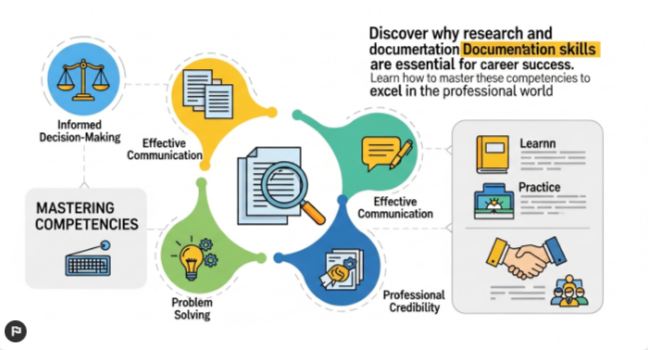
In the modern professional landscape, the ability to gather information and present it clearly
isn’t just a "nice-to-have" bonus. It is the foundation of every successful career, from
engineering and medicine to marketing and law. We live in an era where data is everywhere,
but the talent to filter that data and turn it into a structured, usable document is surprisingly
rare. Mastering these two pillars—research and documentation—sets the stage for long-term
authority in any field.
The Power of Methodical Research
Research is much more than typing a few words into a search engine. It is a systematic
process of investigation. To be a great researcher, you must be able to identify credible
sources, verify facts, and synthesize different viewpoints into a cohesive understanding.
In a professional setting, poor research leads to expensive mistakes. Imagine a marketing
team launching a campaign based on outdated consumer trends, or a developer using a
flawed library for a new app. The consequences are immediate and often damaging. High-
quality research requires patience and a critical eye. You have to look at the "who, what, and
why" behind every piece of information. By doing so, you build a level of expertise that
others can trust.
Documentation: The Art of Clarity
If research is the engine, documentation is the vehicle. You might have the most brilliant
insights in the world, but if you cannot record them in a way that others understand, those
insights stay locked in your head. Proper documentation ensures that knowledge is shared,
preserved, and actionable.
Think about a complex project at work. Without a clear paper trail or a detailed manual, the
project falls apart the moment a key team member leaves. Good documentation isn’t about
using big words; it’s about being precise. It’s about creating a roadmap that someone else
can follow without needing to ask you a dozen questions. This skill is particularly vital for
students transitioning into the workforce. Navigating these high standards early on is why
many students find that assignment help australia provides a necessary blueprint for
professional-grade writing.
Why Technical Accuracy Matters
Accuracy is the heartbeat of trust. When you document a process or a finding, your
reputation is on the line. In industries like healthcare or aviation, a tiny error in
documentation can have life-altering results. Even in less critical fields, errors suggest a lack
of care.
To maintain high standards, you must double-check every figure and cross-reference every
claim. This level of rigor is what separates a novice from a professional. When your peers
and supervisors see that your work is consistently accurate, you become a "go-to" person in
your organization. This reliability is the most direct path to leadership roles and career
advancement.
Overcoming the Information Overload
We are currently bombarded with more information in a single day than people a century ago
encountered in a year. The challenge isn't finding information; it’s ignoring the noise.
Masterful researchers know how to stay focused on the objective.
Setting clear parameters before you start is essential. Ask yourself: What problem am I
trying to solve? Which sources are the most authoritative? By narrowing your focus, you
save time and produce a much higher quality of work. This focused approach is a habit that
should be cultivated during your university years. If you find the volume of coursework
overwhelming, it is often a smart move to pay someone to do your assignment who
understands these professional research protocols, allowing you to study their methods as a
guide for your own future projects.
Bridging the Gap Between Theory and Practice
University assignments are often seen as "just homework," but they are actually simulations
of real-world documentation. A lab report is a precursor to a technical white paper. A
literature review is training for market research. Every time you cite a source correctly or
structure an argument logically, you are practicing a skill that will pay your bills in the future.
Companies today are not just looking for people with degrees; they want people who can
communicate complex ideas to stakeholders. If you can take a mountain of raw data and
turn it into a five-page executive summary that is easy to read, you are indispensable. This
ability to simplify the complex is the ultimate hallmark of a master communicator.
Building Authority through Consistency
Consistency in your research and documentation builds a personal brand of trustworthiness.
When you consistently provide well-researched briefs or clear project logs, you are
demonstrating your value every single day. People start to rely on your documents as the
"source of truth."
This status doesn't happen overnight. It comes from a commitment to excellence in every
email, every report, and every presentation. It involves staying curious and always looking
for better ways to organize information. Whether you are using digital tools to manage your
citations or refining your proofreading process, every small improvement contributes to your
overall professional authority.
The Long-term Value of Documentation Skills
As you progress in your career, the nature of your work will change, but the need for
documentation will remain. Managers spend a huge portion of their time reviewing
documents and making decisions based on them. If those documents are flawed, the
decisions will be flawed too.
Investing time now to learn the nuances of research—how to spot bias, how to use primary
vs. secondary sources, and how to format data—is the best investment you can make in
yourself. These are "portable skills." They don't just apply to one job; they move with you throughout your entire life.
Conclusion
Becoming a master of research and documentation is a journey of continuous learning. It
requires a blend of curiosity, discipline, and a genuine desire to be clear. By prioritizing these
skills, you ensure that your voice is heard, your work is respected, and your career has a
solid foundation for growth.